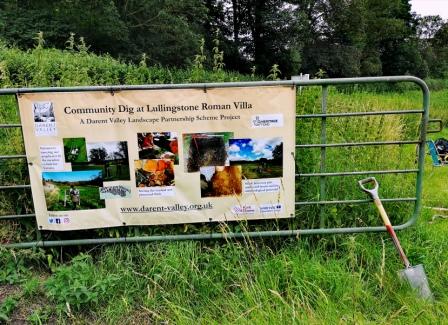
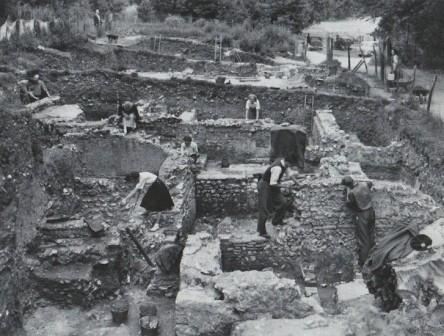
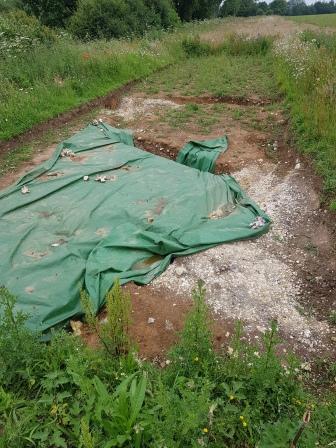
Excavations/clean-up is getting underway at Stringmans Field from 8th to 19th July (no weekend). We are giving the trench a tidy, extending the existing slots to reveal more of the barrow structure, and put in a couple more to get the extent of the ring ditch. The aim at the end of the two weeks is to gather enough information to draft a full report, then backfill by machine. Click here to view the excavation strategy.
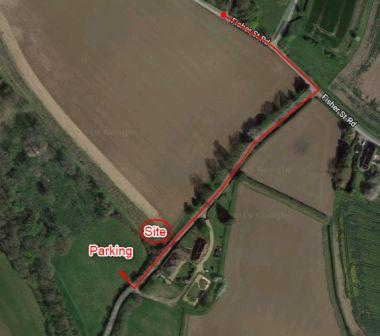
Meet on site at 10 am….parking is in the adjacent field (see above) but the estate has asked if we keep parking to a minimum as that field is currently in meadow, and they’ve done a bit of extra tree planting.
Because of parking restrictions and the fact that it’s a fairly compact site, we’ll need to keep numbers low (max of eight per day) so contact Richard if you are interested in digging.
We are working with Lees Court Estate and the Kent Archaeological Society on this project.
Clay pipes found in archaeological contexts come in a variety of shapes (see chart above). One of our volunteers reconstructed the fragments of a porcelain pipe found on the Spur Battery excavation to show us what shape it would have originally held (see below.)
Rachel Tyson (with contributions from Sarah Paynter and Mahmoud Hawari) has produced a report concerning the Islamic glass excavated from the site of Randall Manor, Kent. We have produced sections of the report below. For the full article please contact Andrew.
A large fragment of an enamelled, and originally gilded, colourless glass beaker was excavated from a midden of probable 14th-century date at Randall Manor in Kent. It is painted with an Arabic inscription and coloured enamel decoration in a style belonging to medieval Mamluk Syria and Egypt, and is a rare find in Britain. It is from a cylindrical beaker, with a narrow body diameter of only about 45mm, flaring out at the mouth, around which a horizontal band contains part of a eulogistic inscription.
The coloured enamel shows decoration within an almost complete ‘medallion’, and parts of further painted decoration to either side. The main medallion is an enclosed design with a rounded lobe on either side, and a pointed arch at the top and (partially missing) bottom. The outline of the medallion and a small central oval are painted in red enamel, with white enamel infilling most of it, and a blue enamel linear design on top of the white; this blue design is partly degraded so the precise design is unclear, but it appears to be symmetrical, forming a pattern of curving lines of arabesque or floral style.
The glass was analysed by Dr
Sarah Paynter of Historic England, previously English Heritage (Paynter 2014),
using SEM-EDS.[1]
This showed the glass to be a soda-lime-silica glass made using plant ashes,
and decolourised with manganese oxide, of very similar composition to published
analyses of other Islamic colourless glasses with painted decoration. Analysis
of the enamels showed that the white was coloured using tin oxide mixed with
lead oxide, the blue was coloured with cobalt oxide, and the red colour was
probably from iron oxide (ibid.). This is all consistent with Mamluk glass.
[1] A scanning electron microscope with energy dispersive spectrometer
This beaker fragment is a very rare find. Only six other gilded and enamelled Islamic glass vessels have been excavated in England, and only two of those come from beakers. Several fragments of a beaker from a pit with 15th-century pottery in Lombard Street, Abingdon, are decorated with coloured enamel and gilt decoration including an unidentified Mamluk emblem, part of the inscription ‘Glory to our lord the sultan’ and figural decoration of mounted horsemen with polo sticks (Wenzel 1984; Tyson 2000, 95–7, g172). A single beaker fragment from Swan Lane in London with part of a gilded and enamelled inscription was excavated from a late 13th to mid 14th-century dump within a waterfront revetment: not its original place of use although this is likely to have been within the City of London (Tyson 2000, 95–7, g173).
There is debate about how these vessels made their way
to England. In the past there has been an assumption that they were brought back
from ‘the Crusades’, although this glass post-dates that period. It is possible
that they were acquired while travellers were in the Middle East on pilgrimage;
the Irish friar Simeon Simeonis, who wrote an account of his pilgrimage to the
Holy Land in the 1320s, noted the high quality of the decorated glass in
Damascus (Irwin 1998, 25). John Carswell has identified a number of Mamluk
gilded and enamelled beakers that show images of sites in Jerusalem connected
with pilgrimage, and likely to be pilgrim souvenirs (Carswell 1998). Or was the
glass among ‘exotic goods’ brought back by merchants, such as the Venetians,
and then sold in the West?