Living in Gravesend and Cobham

No. 11 The Overcliffe

We lived at no. 11 The Overcliffe, Gravesend.  Old Tom (that’s what we called mum’s husband). One night he told mum he would take me out with him, I didn’t want to go but in those days you had to do as you were told.  Well he took me down the water front and he went into this pub, he did bring me a bag of crisps outside.  I am left standing in the doorway when an awful storm blew up, thunder and lightening I was scared stiff, much too frightened to move.   I could see all the brass inside the pub, mum used to cover all the mirrors and anything else shiny in a storm and take her clips out of her hair also clear any knives and forks from the table so I was sure we would be struck dead with all the lightening.   At last he staggered out to take me home.  By the way, where we lived was a ground floor flat.  When we got home mum was flooded out, there was water everywhere, all the furniture was soaked, so the next day mum went out and got a new flat (it was easy in those days to rent houses).

No. 63 Darnley Road

We moved to no. 63 Darnley Road, Gravesend.   It was an upstairs flat this time.  Ivy started work at fourteen years.  She worked as a housemaid for people at New Barn.  She used to catch a bus to and fro.  When she was fifteen she had a boyfriend.  Tom didn’t like this he was always picking on her.  Mind you it showed how Ivy really hated him.  Lena and I went to St James’s school just at the bottom of the road, near Gravesend hospital.  It was a funny little school.   The teacher gave us lessons on getting babies.  She drew a circle on the blackboard and said ‘ an insect gets into a woman’s stomach and forms a baby’.   Well I did not believe it but when I went outside to play, the air was full of insects, well I kept my hand tight over my mouth, I certainly wasn’t going to chance swallowing any of those blighters…. I did find out at a much later date but that will come later.  No good asking Lena…

Anyway getting back to Ivy, she would stay out quite late, mind you that would be about eight or nine in the evening.  Old Tom used to hit her (never could understand mum letting him).  We asked our friend God to help us again, please let Ivy get in early but Ivy didn’t care she used to say it didn’t hurt.  She wasn’t going t do what he told her to do.  We didn’t know at the time what was going on.

No. 8 Gordon Place

Eventually we moved to a small house, it was nice, no. 8 Gordon Place down near Gravesend promenade, quite near the Gordon gardens.  On Sunday evenings in the summer they would have a big band in the grounds, when they finished they would play the national anthem, I would jump out of bed to stand to attention.  Lena used to moan and say ‘I will tell mum in the morning’ mum only laughed and told me not to keep doing it but it made no difference.

One day I came home from school and mum had gone to the pictures with Lena.  I had moved to a new school by now, Saint James had closed and I had to go to Saint Georges right up by Woodlands Park , two miles from our house.  I used to come home for dinner, there was only myself and a girl called Marianne Lane who lived in Parrock Street. Everyone else stayed to dinner.  Mine was the very first uniform ever made for that school, it cost five shillings and the red sash was one shilling.  It was a nice school.  Vi gave me the money for the uniform and also bought me a lovely red jumper to wear with it.  Lena had just left school at fourteen she was going into Henley’s factory to help make gas masks for the war. (hence she was with mum).  Anyway as I walked inside the house old Tom was waiting for me, he said ‘your mothers not in I’m here on my own with you’.  I was really scared. He looked at me oddly.  He grabbed me and tried to pull me on his lap, he was shaking, I thought he was having a fit, then he tried to put his hand up my skirt.  Well I knew that was really wicked, so I yelled my head off, I was crying and saying I will tell my mum when she gets home.   See if I don’t…. Well he said I will tell the police of you, they lock kids like you up what tell lies.  I said I will tell them about you and he said they won’t believe you, when you go up the market you look down near the floor you will see grids on the wall, they whip you every day and keep you in the dark with rats running around.   Well I go to the market and sure enough, there are grids so now I am frightened.  I just sit and cry.  He said there is no need to tell your mother, I only sat you on my lap.  I said if you do it again I will tell mum.  Oh get out of my sight, so I did.  Well I never told anyone.   Life carried on for a while.  One day I had saved enough money to buy a pint of milk I went up the alley and drank it all.  I had promised myself when I grew up I would do this. My god was I sick afterwards, it taught me a lesson not to be greedy !

Poor Ivy

One day Lena and I was playing ball outside our house, when all of a sudden two big policemen came tour house.  We were pushed out of the way.  When we went indoors mum was crying, she told us that poor sister Ivy had drowned at the place where she worked.  She was just sixteen years old.  It was awful.  She had been such fun to be with.   She was buried in Gravesend cemetery, I wouldn’t know where, she didn’t have a headstone, in fact she was in a grave with other folk because it was a lot cheaper.

Lena and I used to go to the cemetery to try to find it but we never did.  We did do one bit of good though.  The posh people used to put glass globes tops with flowers on their graves, well some would have four or five.  So we used to share them out and put one on each grave so it was fair!   We thought it was our good deed for the day.

Old Tom used to go to sea, he was a stoker on the dredgers, before he married my mum.   His name was Tom King (same surname as my dad but supposed not to be related but I often wondered) we were never allowed to ask about anything like that.  Mum would say it doesn’t concern you madam.  So it was best to say nothing.

Moving to Cobham

Time went on then it was time to move to Cobham.  Tom had got a job looking as a night watchman over the big guns to be used in the war to shoot the Germans down before they could bomb London town.  We had a nice little house, no. 7 The Street, Cobham,  right opposite the Old Curiosity Shop.  A lady called Mrs Hoppe ran it.  Nearby was a café called Little Dorrit that was run by Mr and Doris, Rene and Ken (not married) they were all very nice.  We all shared one tap in the back yard and two big wash houses, with two big coppers to do the washing.   Lavatories were up the garden but they did have flush away toilets (quite posh).

During the war we had all sorts of troops coming through the village, sometimes they would lean up mum’s wall and she would take them out mugs of tea and say ‘poor little devils, they are somebody’s sons’.  They were billeted all over the woods.  They lived in Nissan huts.  There were three cafes in the street in those days, one in the baker’s shop, the Little Dorrit and another old girl Miss Doris Usher opened her house.  She used to do eggs and chips, stuff that was cheap and easy, just what the lads wanted, in fact I think they got most things they wanted in the village!

Esme used to be on the switch board some times.  One night she spoke to John Mills the actor, he was staying at the Leather Bottle making a film (Great Expectations).  Esme had to tell him his time was up on the telephone.  She heard his wife say ‘how dare they’ ‘do they know who you are’ John Mills said, ’darling they can hear us’ so she said ‘oh tell her to f… off and you as well’.  The next day when he came to the village he looked into the window where Esme was working and tapped on the window, smiled wetly and ‘hello’.

About Aunty Esme, she met Richard her husband during the war, he was in the navy and billeted in Laughing Waters grounds in a Nissan hut.  She came to stay with me to give birth to her son David.  I will never forget, Richard came home on leave, Esme sitting up very proud on my bed, he took one look at his new son and said ‘cor blimey Es he will have to screw his hat on he had so many wrinkles!  Poor Es was quite hurt but they were soon all smiles again.

Jen (my daughter) was only five months old, so I had plenty to do.   No washing machines then.


Posted in Oral History | Tagged , , | Leave a comment

Ebbsfleet, Thanet

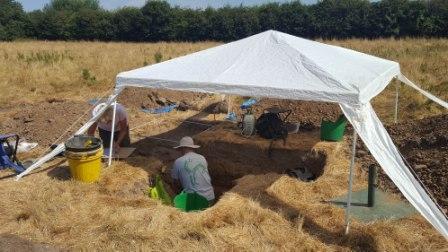
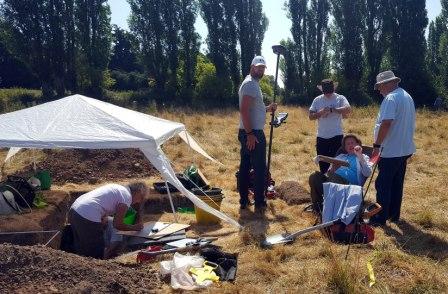
From 2015-2017 the team was involved with the work at Ebbsfleet, Thanet, to find evidence for Julius Caesar’s first landing in Britain. Excavations during this time were supported by the Leverhulme project and the University of Leicester.

Click here for research published on the excavation: ‘Ebbsfleet, 54BC’ by Andrew Fitzpatrick, Current Archaeology,  vol. 337, pp.26-32.

In February 2021 a YouTube talk was held by the Kent Archaeological Society covering the topic “Caesar in Kent: Did he land at Pegwell Bay?”.  Click here to link through to the talk.

Field walking in 2015

2015 Strategy notes

2015 Special finds

2016 Final day

2017 The site

2017 Special find

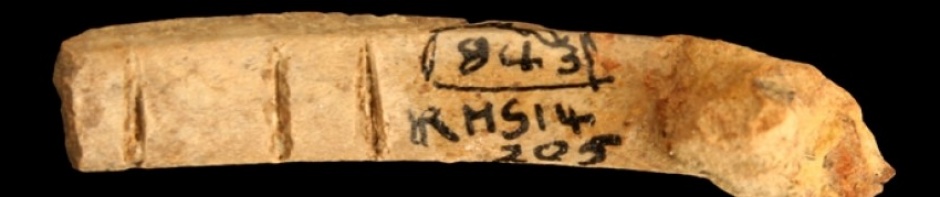
2017 bone find

2017 trench

(*Images copyright R. Smalley)

Posted in News & Events, Research, Sites | Tagged , , , | Leave a comment

The Hollow Way, Cobham Woods

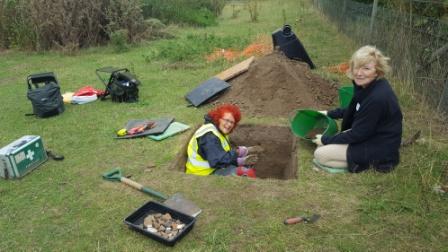
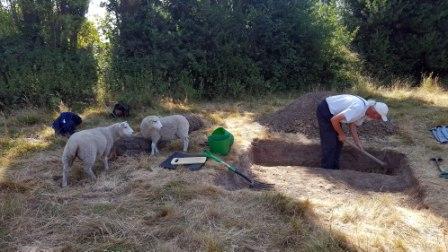
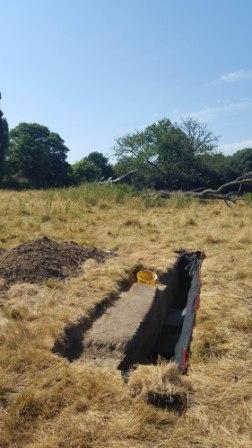
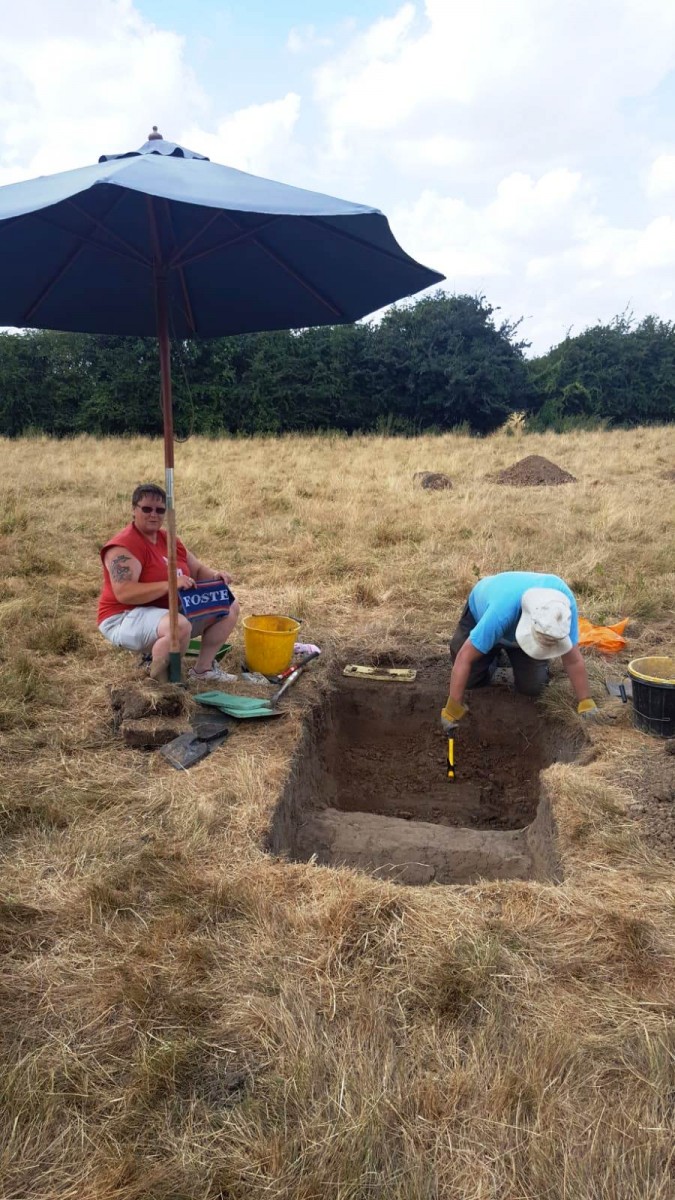
The aim of this dig was to date both the Hollow Way and hopefully the field systems either side of it. So far we have everything from prehistoric worked flint, to medieval pottery, to a Victorian gin bottle.

LiDAR of the Hollow Way area

We also have a metalled road surface (below), so it looks like the track was looked after. We can see it on the 1641 Norton map, but the finds suggest it is probably medieval in date.

Possible medieval metalling at base of the Hollow Way in Cobham Woods


Posted in News & Events | Tagged | Leave a comment

Catherine Weed Barnes Ward at Cobham c.1901

Catherine Weed Barnes Ward (alternatively Catharine) was a pioneer in the field of women’s photography at the turn of the 20th century. She was born in Albany, New York, and later moved to England. She was a feminist of the day supporting the right for women to be photographers. In 1890 Catherine became an editor for American Amateur Photographer magazine. She joined associations that were usually reserved for men (women were generally not allowed to be members of American photographic clubs, unlike their British equivalents) such as the National Photographers’ Association of America and the Camera Club of New York. Her work won awards at amateur exhibitions.

In 1892 she travelled to Britain where she met Henry Snowden Ward, an editor of photography journals, whom she married.  From 1901 the Wards lived at Golden Green, near Tonbridge, Kent, and together produced a number of books in which Catharine took the photos to go with her husband’s text.  The images reproduced here came from this period of her life. 

The Kent Archaeological Society holds roughly 300 glass negative slides taken by Catherine Ward.  Those below feature Cobham’s famous Leather Bottle Inn (a favourite drinking haunt of Charles Dickens and featured in ‘Pickwick Papers’), the park and the Hall.  They help add to the rich history of Cobham uncovered by the Cobham Landscape Detectives project and its volunteers.

The Leather Bottle

KAS ref B04-03

KAS ref B04-09

KAS ref B04-02

Cobham Church and Hall

KAS ref B05-13

KAS ref B05-02

Cobham Park: featuring the woodlands, Roman remains and standing stones

KAS ref B05-01

KAS ref B04-12

KAS ref B05-04

KAS ref B05-05

KAS ref B05-12

KAS ref B05-06

KAS ref B05-07

Sources

  1. Wikipedia, https://en.wikipedia.org/wiki/Catharine_Weed_Barnes, accessed 16 June 2018,
  2. Kent Archaeological Society, http://www.kentarchaeology.org.uk/07/00.htm, accessed 16 June 2018
Posted in Research | Tagged , , , , | Leave a comment

Vince (aka Paul) Dale: memories of Ashenbank Camp

I was born in Ealing Hospital on the 6th November 1942, during the blitz, I was too young to remember it but we were bombed out and had to move.

My first memory is of being four years old (1946) and moving into the disused RAF camp, on the South side of the A2, in what I knew as Cobham Woods. We lived there until 1951 when we were allocated a council house on Shorne Ridgeway.

My father had been in the navy and must have heard about the camp from some of his shipmates as I believe the Navy took over the camp from the RAF and there may already have been ex-navy personnel living in the camp. We were lucky enough to find a very large double hut shaped like a capital H and moved in as squatters. My parents made it into a three bedroom dwelling and it also meant that there was plenty of room for my sister and me to run around in. Later on the camp was taken over by Strood District Council and started charging rent for the huts.

The right hand upright (of the H) was my parent’s bedroom, the cross member was mine and the left hand upright was my sisters bedroom, living room and at the bottom the kitchen and toilet. There was no bathroom, like a lot of people at the time we had a galvanised tin bath. Times were hard and we didn’t have many possessions. All I can recall are, three beds, dressing table, wardrobe and table and chairs in the living room.

Cooking was done on an electric hob/oven and the heating was from a Queen Anne coal fire stove in the living room. In the winter the rest of the building was in sub-zero temperatures. At the rear of the hut there was a large circular coal yard surrounded by a high wire fence. There was a reasonable amount of coal in the yard that I’m sure my parents must have made good use of.

My mother made a garden in front of the hut for us to play in and in the middle was a very large, old oak tree that was decaying at the base of the trunk. This was home to some gigantic stage beetles that we played with, trying to make them race against each other. Surprisingly, we had no fear of these fearsome looking creatures.

Across the road from our hut was a large fire water tank that must have been 6 to 8 feet high by about 15 to 20 feet in diameter and painted a dull rusty red/brown.

Next door to this was a two storey brick built building that was about the size of a large house. We were told this was a de-contamination building in case of chemical attack (this was never confirmed) and were warned under threat of severe grounding never to go anywhere near it. In fact we were so scared we always gave it a wide berth.

The ground where our hut in the woods once stood is now gone, the cutting for the high speed channel tunnel link has taken its place!

At the top of the road, on what was once the old Watling Street was a little shop and I was given to believe that it had been the gatehouse/guardhouse to the camp when it was used by the military.

One of our ‘playgrounds’ that we used quite often was the Gravesend Airfield. Another pastime, as autumn arrived, was to collect and bag sweet chestnuts that were sold to Lord Darnley at Cobham Hall.

While we lived at the Ashenbank camp I attended Cobham Primary school and it looks exactly the same today as it did then. We used to walk to and from school with virtually no traffic on the roads it was quite safe. The school always seemed to be cold and the daily bottle of milk (one third of a pint) was compulsory. The bell on the school roof was rung at the end of play time and dinner time and we had to line up in our age groups before we were marched to our relevant classrooms. I can remember that my time at Cobham school was very happy but had to come to an end when I was eleven and moved to Southfields, a very frightening experience for a little country boy.

Cobham Primary School today

There was a sweet shop just along the road from the school that was run by an old lady from her front room. We would go in there once a week with our three penny piece (known as thrupence) and ration book. We spent the thrupence and the old lady took one stamp out of the ration book. It is now a private house called ‘The Candy Box’, opposite the church and  a couple of doors up from ‘The Leather Bottle’, an old haunt of Charles Dickens.

A couple of years after we moved to the Ridgeway I left Cobham Primary School and went to Southfield Secondary Modern School.

My father managed to get a job at the clay works, which was on the North side of the A2 and is now in Shorne Woods Country Park, where he worked for several years. The clay works was out of bounds to children but occasionally dad would smuggle us in and we would sit in the little tea hut in front of the oil drum brazier drinking hot sweet tea made for the work gang. As a lot of workmen did back then, they used Fussells condensed milk instead of sugar and milk which made the tea very sweet!

The giant crane dug out the clay, swung round and deposited it onto a seemingly endless conveyor belt that took the clay to the other side of the pit to be loaded on to eight wheeler lorries and transported to a cement works near Cuxton alongside the river Medway.

Ashenbank Camp

This was all a long time ago but my memories are quite vivid and I can still visualise the layout of the camp and have drawn a map to go with this text. I also have two photographs from when I was living in the camp.

Posted in Oral History | Tagged , , | 5 Comments