Peter Dadson: memories of Shorne Woods Clay Works

I lived on Painters Ash Estate and went to Colyer Road school (Now Northfleet School for Boys). I left there in 1959, when I was 15 and went to work for Blue Circle at Bevan’s cement works, Northfleet. I wanted to do an apprenticeship but couldn’t start before I was sixteen, so worked in the Electricians workshop, as a ‘shop boy’ for a year. As the ‘shop boy’ I did all the odd jobs that anybody wanted, or needed, doing.

Once I started my apprenticeship I worked with the electricians and this was when I started going to the clay works in Shorne Woods (in those days it was known as Cobham, it became Shorne after the widening of the A2 in 1963). Breakdowns were not a common occurrence so I probably only went there about once a month, when we were called out to solve a problem. We dealt with anything electrical including pumps, lights and conveyors.

One day there was an OCB (Oil Circuit Breaker) fault which meant the power house shut down but work didn’t stop as there was always twelve hours of slurry in the tanks.

As far as general operation was concerned, the navvy (mechanical digger) dug the clay out and tipped it into a hopper, the hopper fed the conveyor belt and the conveyor belt fed the clay into the coarse (also known as rough) wash mill.
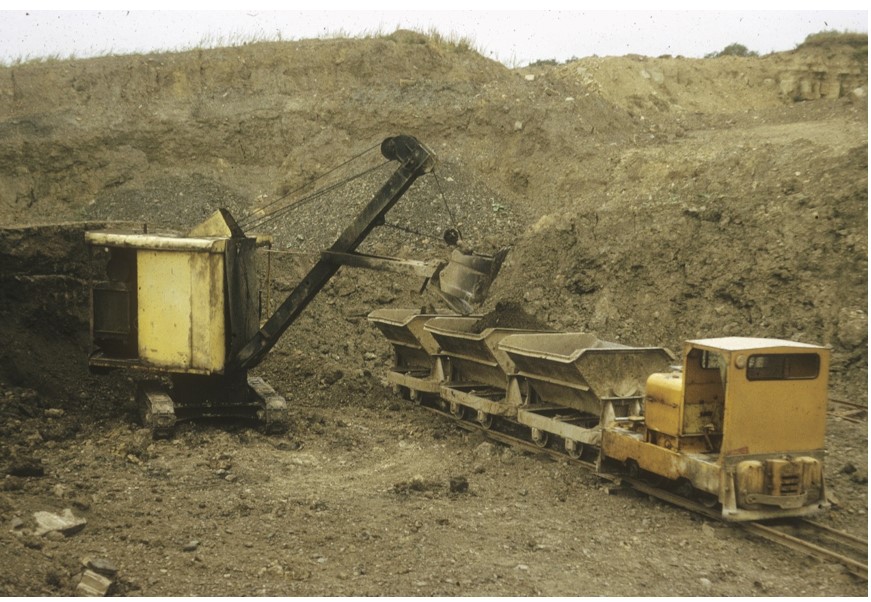

Although not taken at Shorne, this photo shows a navvy and a narrow gauge railwaythat are similar to those used at Shorne and other clay works

There were two wash mills, the first was the coarse/rough wash mill and the second, the fine wash mill.

The clay was tipped into the coarse/rough wash mill and washed and sent through sieves to the fine wash mill. The men would have to go into the coarse/rough wash mill monthly to clear out the flint and gravel that had built up.

From the fine wash mill, it went into the slurry tank and was then pumped all the way to Bevans cement works at Northfleet.

The conveyor belt would be moved as and when required. The train track was also moved but they had to be careful that the ground could take the weight of the engine and loaded wagons. There is one section of the conveyor, left in situ, that  could be seen above the surface of the larger of the two fish ponds but has now sunk into the clay.

The slurry was pumped from Shorne, through a pipeline, alongside the A2, to the ‘Tollgate pumping station’ (the pumping station is behind where the Toby Carvery is now and not Northumberland Bottom, as we have been told previously) there were three Orenco pumps that pumped the slurry to Ebbsfleet. I’m not sure of the exact route the pipeline took from the Tollgate but I think it followed the line of the river Fleet and finally to the quarry. The three pump operators were Billy Tremain, Albert Stroud and Mr Taylor.

The pumping station was kept running 24hours a day and was covered by the three shift system. An example of one man’s shift pattern is –

Saturday 10 -6 back in Sunday 2 – 10 back in Monday 6 – 2. Only one man allowed off at a time and the shifts would be covered by the other two men doing 12 hour shifts. Nobidy took weekends off as these were paid at a higher rate, time and a half for Saturday and double time for Sunday. If there was a need for extra cover there was a backup man, trained to run the pumps,  at both Shorne and Northfleet that could step in.

On one occasion; the pipe line split at the Tollgate and there was slurry all over the A2 that stopped the traffic. A mechanical shovel was sent out to clean up. They were working into the night when the police stopped them as there was no rear light on the shovel. The problem was solved by two men with red lights walking behind the shovel for the rest of the night.

We used to go into the canteen for a sit down and a cup of tea, it was a typical works canteen, not particularly inviting!

One day, one of the old men on the pumps said “do you like pheasant”, I told him I didn’t know as I’d never tried it, to which he said “come with me”. He made a small hole in the ground and put a paper cone in it, smeared it with treacle and sprinkled corn into it. The pheasant would put their head in the cone and the treacle made it stick to their head. They couldn’t see anything and were easy pickings. When he had caught one his words were “thank you Lord Darnley”.

Flint, that had been extracted when the raw clay was put through the sieves in the coarse wash plant, was taken to a company called  Flintag that was at Stone marshes (near Dartford). Some of It was crushed, coloured and used for aquarium gravel and some sent to potteries for use in ceramics. It was also used for non-slip flooring by mixing with epoxy resin. (Flintag aggregate is still available today.)

Some of the navvies were electric and powered through a cable from the power house to wherever the navvy was working. It was a frequent occurrence for the cables to be run over. The further away from the power house, the larger the cable, to ensure the voltage required reached the navvy.

There were two engines and two navvys on site but only one of each was working at a time. The engine shed was where the engines were repaired or kept when not being used.

Trevor told me that there were train tracks on the upper South bank but I don’t have any knowledge of these. (Trevor – it could be that these were out of use by the time that Peter worked at Shorne).

After 20 years, I received a tie and after 35 years I received another tie and a pair of gold cufflinks and certificates for both.

As told to Trevor Bent January 2022.

Posted in Oral History | Tagged , , , | Leave a comment

Volunteers hard at work last week – the Battery

Posted in News & Events | Tagged , | Leave a comment

CITiZAN at Sandwich Bay – February 2022

There is a continuing project happening at Sandwich Bay for surveying 18th– mid 20th century stake net (fish trap) remains.

CITiZAN and volunteers will return to the site next week, 18-20th February to carry out some archaeological sampling of the stakes – no experience necessary and all welcome! 

Contact Lara at lband@mola.org.uk or go to the website for more details on how to take part – https://www.citizan.org.uk/blog/2020/Jul/17/stakes-and-ships-sandwich-bay-kent/

The plan: is to take up to 60 timber samples over the three days from the fish trap stakes: cutting the top c10cm with a small handsaw and bagging them, recording this with the RTK. This time we’ll also be photographing each one before we saw it, and each ‘run’ of stakes we sample, with a scale and with a normal camera and the RTK camera. We’ll also record any other stakes we find, that haven’t been recorded yet.

After we finish we’ll go to Princes Lodge bar and café for a warm drink and a debrief (CITiZAN will pay). CITiZAN can also pay your toll road fee, so keep any ticket you’re given and give it to me at the end of the morning. Remember your wellies and wrap up warm!

Posted in News & Events | Tagged , | Leave a comment

Cobham Woods

Today some of SWAG took a walk in the Cobham Woods to look for the Darnley toe memorial. They uncovered a number of pieces of stone, the column and the base.

For more details about the incident that led to the creation of this monument visit the blog of Geoff Rambler – https://geofframbler.blog/2020/07/13/memorial-to-lord-darnleys-toe-1835/

Posted in News & Events | Tagged , | Leave a comment

Ted Goodwin and his sister Patricia Cox remember their Dad and the Clay Works in Shorne woods

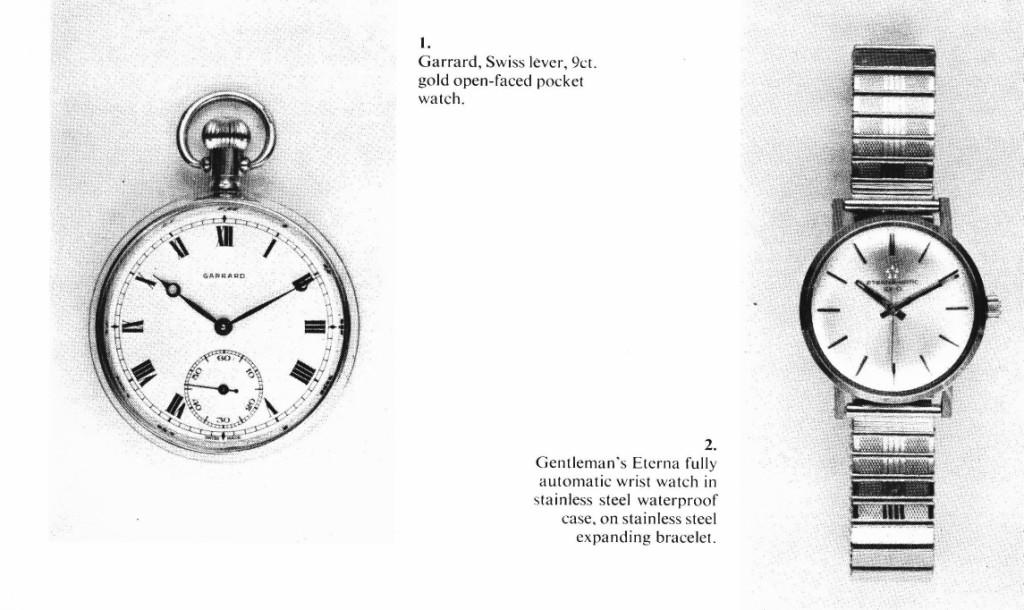
Our dad’s name was Edgar (Ted) Amos Goodwin and our mum was Rosina. Our dad was born in 1910 and worked for AEI at Northfleet for 25 years before taking the job of Wet Miller, in the wash plant at the clay works in Shorne Woods and worked there until its closure in 1964. (The wet miller would have been responsible for keeping the wash plant running).  He transferred to Swanscombe chalk pit and worked as a pump attendant and completed his 20 years-service with APCM, for which he was awarded an Eterna Matic 1000 wrist watch.

He continued to work there, until he retired in 1975, when he was presented with an Ingersoll stainless steel pocket watch.

The 20 years-service wrist watch was selected from a Blue Circle Group (a group within the APCM group) catalogue that also included a pocket watch, ladies watch, two gold bracelets, two lever clocks, silver plate tea set, cutlery set, teas made and binoculars.

The catalogue page showing the watch that Edgar Amos chose after 20 years of service

Eventually, due to length of service at Shorne, he was made up to foreman. This didn’t sit easily with him as he found it difficult to give orders but it was made easier as he treated the men well, which they appreciated and helped him when needed.

Raw clay and water were fed into the wash plant and turned into slurry by mixing them together using giant rotating blades. The slurry was then pumped to Bevans cement works at Northfleet, some six miles away, via a pipe line that ran underground alongside the A2.

Our dad sometimes took us to his workplace and we would have wait to be picked up by truck, at the General Gordon (a public house that stood in Cedar Avenue until it was destroyed by fire in 1992). We would be in the back of the truck, that had a canvas roof, together with some of the men being taken to work. Dad didn’t always go to work in the truck as on occasions he cycled.

The bus route from Kings Farm Estate to Shorne would not have been very frequent, which is probably why APCM provided the truck.

We entered the clay works site from the entrance on the A2 into what, to us children, looked like a forest. Our father used to say ‘be careful of the lions and tigers’, needless to say, we never saw any.

When we were on site we had to stay with our dad so consequently never really went very far away from the main area. Not always but mainly, we went at weekends when it was quieter, no bosses around!

Whenever we went on site, we went into the canteen building and there always seemed to be a roaring coke fire in the combustion stove. We used to have a cup of tea whilst sitting on one of the benches but don’t remember there being any other furniture in the room.

On one occasion the men cooked breakfast (now called a traditional English breakfast) on an upturned electric bar fire, whether this was a regular practice we don’t know but suspect that it was!

There were always cats around that were kept to keep the rat population down.

On one of our visits we watched as he put on waders to go into the slurry tank to clear a blockage, with shouts of ‘be careful’ following him in.

It was a 24 hour a day operation so the men had to do shiftwork to cover this, these were 6 to 2, 2 to 10 and 10 to 6 shifts. Sometimes it was needed that shifts would be 12 hours long to cover staff shortages.

The only names of people who worked there that we can remember are Bill Young, Spud Taylor and his brother Reg.

It was a really cold, bleak place in winter, dad suffered with rheumatism in his shoulder and would often need help taking his coat off when he came home. All the men wrapped their feet in strips of cloth, that were always referred to as toe rags, before putting on their ‘wellies’, to try and stop their feet from freezing. Dad always used Sloan’s liniment for his rheumatism which ‘stank to high heaven’! Mum told us the story of a special evening for them that she had planned, putting on her best clothes and perfume but dad came home smothered in Sloan’s so the evening didn’t turn out as she had hoped!

Rosina and Edgar on the beach in the 1960s

When we were on site, we played with homemade bows and arrows and in the autumn collected chestnuts, that we roasted in front of the fire at home.

The only accident that we know dad had was when he stood on a rusty nail and had to go to hospital for a tetanus injection.

Old railway sleepers were cut up and brought home to be burnt on our fire.

The Christmas party at the APCM club house in Northfleet High Street was always something to look forward to.

From Ted :

I had rides on both the train and the conveyor belt, sitting in a tipper truck on the train and the rubber belt of the conveyor, quite exciting for a young boy. The trucks were about 6’ long and 3’ wide and the conveyor belt about 2’ 6” wide.

The train engines were diesel and had to be started with a hand crank, two men had to turn it and when it was going fast enough one had to let go and pull on the three compression knobs for the engine to start.

I still have two, line posts on my garden that were brought home from the site.

As told to Trevor Bent and Don Blackburn, November 2021. Ted & Pat have agreed that all or part of this may be used in any future publication.

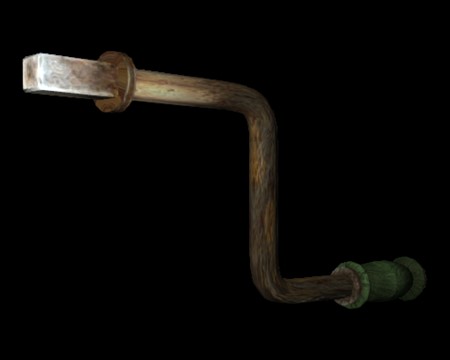
Note from Trevor: during recent SWAG excavations at the clay pits we found a crank handle with a square hole, that would have been used to start the train engine.

Crank handle excavated at Shorne clay pits

A crank with a solid square end, similar to that pictured below, would have been used to start the train engine.

Posted in Oral History | Tagged , , , , , | Leave a comment