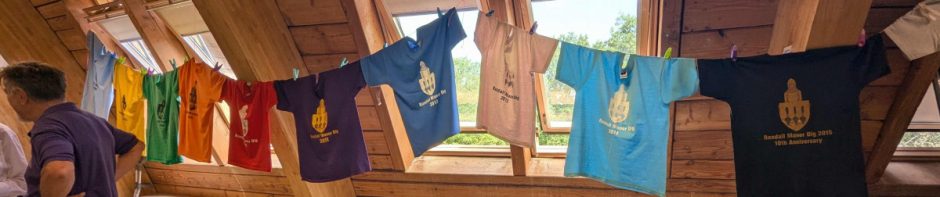
When we lived in Gravesend we didn’t live far from the swimming baths as you know. My mum said you are not allowed in the water until you can swim, so I had an old chair without a back on it so that I could practise. I would put my tummy on the chair and move like a frog, arms and legs going like the clappers. Very good I used to think to myself. So dear Gert knitted Lena and me two swimming suits, ‘arf lovely’, bright red, mine with a big blue letter B and Lena’s was a big L. On Sunday morning you could get into the swimming baths for a penny (that was if you went at seven o’clock). So off we go, put our swim gear on, hat on (mine nearly covered my eyes as well as my hair). It was so exciting, very cold, we put our bands on our legs (we were the only two in there) walked down the steps giggling as well as shivering, got really wet. Well you should have seen the water, all the red dye came out of the wool and when we stood up the crutch of our costumes were around our ankles, we tried to grab it up and tried to wring out the water, the thin little straps looked like string, it was awful. We never wore them again. So I still swim on my chair with all my clothes on…
We could get into the pictures on Saturday mornings for a penny to see Roy Rogers etc. We all used to sing when we got there:
‘ Oh come along and join the party,
Let’s enrol you as a chum with all your pals so gay and hearty,
You can hardly wait for Saturday to come.
So along at every meeting the Majestic takes some beating,
That’s why I shout whoopee, I’m glad I am a union chum’.
We would shout as loud as we could. The film used to follow on just when Roy Rogers was caught in a huge fire…will he get out, see next week. We just couldn’t wait to see. Mind you Trigger his horse was so clever.
We had to go to church every Sunday. At Easter time most people would have a new outfit. Lena had a new coat and hat in blue, it was ‘Deanna Durbin’ style. She did look nice in it though, bless her.
In the winter the ice would freeze on the pond at the bottom of Battle Street, it was not all that deep. We, the whole gang of us would go down on a full moon night to slide on it, being moonlight made it more exciting, boys had to hold us up. None of your ‘hanky panky’ then ‘honest’. I still didn’t know where babies came from let alone know how to make them, we must have been a bit thick.
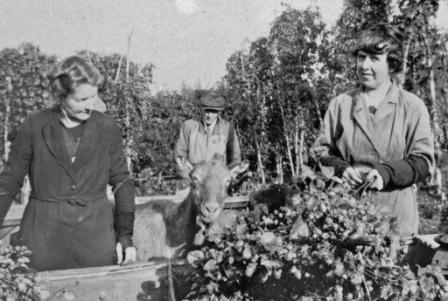
Years ago we used to have a big block of salt, like a loaf. We used to grate it to put it in a salt cellar, also the nutmeg would look like an acorn, it was a swine to grate. When mum made the puddings for Christmas we would have to grate the suet which came in a big skin. Thus the saying, ‘a bladder of lard’. We would all have to help clean the fruit and take all the seeds out. It took a long time and then we would have to go out the next day to the hop fields and find all the old bits of poles and bring them home. Mum would poke them up the copper hole and put a stick across the copper to boil for about six hours, it took ages and they would be made six months before they were needed.
Mum used to keep the bars of carbolic soap in a big box so it went very hard, it would last longer then.
We would pick sage and wash it then hang it up to dry and then put it in brown paper bags to hang in the pantry.
Wash day was all day. Mum would wash it put all the whites in the copper, take it out, then what she would call ‘sudsit’. Put it in clear water, rinse it again then put it through the water that had a ‘Reckitts blue bag’ in a little muslin cloth. Then starch what was needed and put it all through a big wringer with big wooden rollers and finally peg it on a line and prop it up with a big two pronged pole (just a pole each end to hold it tight). I hated wash day.
Dinner would be mashed potato and swede. Poor mum would be wet through with sweat, but she loved to see it blowing in the breeze. I can never remember seeing it get wet with rain.
My brother Fred mended our shoes. When he was angry, which wasn’t very often, he would only have to look at us and ‘dearo dearo dearo’ we would be off like a shot. He was really lovely. We were all proud of him. He built a shed for himself which he used to bath in. His mates would come round and he would put on boxing gloves to spar around. He and Lil got on very well, Lil would have a go at most things, ride on the back of his motor bike. They were always singing and Lil would yodel.
Getting back to Mum’s Dad, he used to wear ‘toe rags’. They could not afford socks, so he would take a strip of old sheeting and before he went out he would bind it round his feet before putting on his boots. Mum said he would do it very neat. They used to wear ‘combinations’ ‘coms’ for short in those days. Men and women wore them. They were like vests with long sleeves and long legged knickers, which came down to your knees, all in one piece. They had a big opening front and back which you just pulled apart to use the toilet. They were made of woollen material which must have made one itch like mad (worse than your petticoat Em).
Food and shops
This is a bit about the food and shops we had. The cheese would be in a thick muslin, round in shape and weighed fifty six pounds before being cut. They would take the muslin off and then a thick skin or rind as they called it. The balls of Edam cheese would cost about 2/6d each for a whole one. Dried peas were sold by the pint, they were all in a large hessian sack on the floor of the shop, they used to have a little block of soda to cook in with them. Dates would also be in one big block and they would cut out how many you wanted. Woolworths was a six penny store nothing was sold over sixpence, they had a rail that went around the stores quite high, the girls would put your money in a little box then put it on this line and pull a lever which would take your money to another assistant who would take it out and put your change into it, then it would run round this bar and bring it back to you. There was always a chair for people to sit on, you needed to sit and wait for your change.
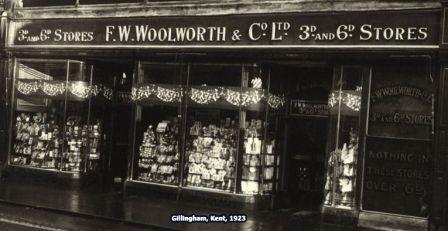
Woolworths, Gillingham, Kent, c.1923
Drapers was another old shop in Gravesend , they sold all really old fashioned gear like fleecy petticoats, long johns, bodices and even fleecy knickers, they used to have three farthings on all of their stock. Then there was Caveys, they used to give you pieces of tin money, after you had collected so many you could get something with it (like reward cards of today). We would get three pen’oth of chips and a big bag of crackling from Maxfield’s fish shop. The fish was nine pence a piece. Milk was tuppence for a pint, the well off kids at school could have little 1/3rd pint bottles of milk for a half penny (too dear for us kids).
As school we had a desk with a hole for the inkwell, we had to dip our pens in it for writing.
The used to sell live animals at the market in Gravesend, dogs, cats, birds, rats, mice even monkeys. By the side of them would be a man selling roasted chestnuts on top of an old barrel. They used to smell lovely. You could also take a basin and get it full of ice cream from Papa’s ice cream parlour for six pence.
Back to Cobham
Now to get back to my youth in Cobham. As I said Vi lived next door to our mum, she now had Barb and Glenys (Gen Gen always called her). She was very tiny but she was the most stubborn child I have ever come across. Well Vi wanted to move up into the house in the wood, right up in Cobham Park past the Mausoleum, very lonely. It was a lovely house, Neville was away in the army so mum decided that I would have to go and live with her and the children. Well we were both very frightened at night so it was decided that Ern came up there to live with us. It was only three bedrooms, I had to sleep downstairs in the sitting room. I couldn’t understand why Ern couldn’t sleep downstairs. Vi’s bedroom had a small nursery leading straight off from her room. There was a huge cellar under the house which had lots of room and was very cold. The sitting room was big, then a hallway with red brick flooring and a kitchen. There was no electricity and in the summer no water. Ern and I would take a big bath down to the farmer’s house to bring water back, the farm was called Knights Place. We were very happy living there. At Christmas Ern would cut the top from an old Ern would cut the top from an old Yew tree or Holly and Vi and I waited until all the nippers were in bed and then we would titivate it with all the bits of toffee papers and made pom poms out of wool. We took a Dr White’s (sanitary towels) to bits for cotton wool and cut silver bits from chocolate wrappers (which we mostly found along the way) and hung holly berries from cotton. We put flour on the earth to look like snow and in the morning Ern would build a nice big log fire then play carols on his mouth organ. We would then call the children to come and see it. On top of the tree we put a star made from cardboard. If you could see their little faces, it made us want to cry. Then we would all sing carols together. For lunch we would have pheasant and rabbit pie for tea. The children would help me making mince pies. After tea we would play I spy or hunt the thimble, saying ‘hot’ or ‘cold’. If we had a balloon we would play for hours until it burst on the holly above the pictures. We would tell those stories and then have a sing song with Ern playing his mouth organ and the rest of us with a comb and paper. If nothing else it tickled your lips and made the kiddies happy. They were really lovely kids.
When I said we lived up the park, it was past the Mausoleum which was built like and Egyptian pyramid it had been built for Lord Darnley’s family when they died. It was a lovely building and had an alter up the front steps and when you went round the back and down the deep steps there were all the divisions for coffins. It was really a vault but it was never consecrated so therefore they could not bury anyone there. It had a six foot or more spiked fence around it, shame it has been ruined now by hooligans. I won’t tell you what was painted on the walls, some very funny things, it is so sad how these things happen.
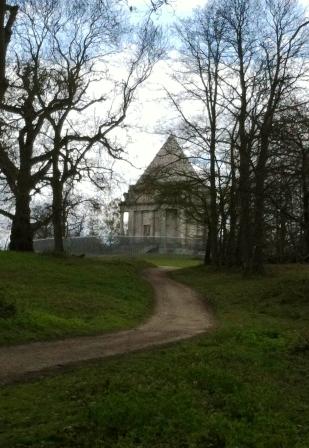
The Cobham Mausoleum today
One night I was walking with Pam through the wood, she said ‘Aunty what is the moon’ it was a very windy night when the clouds raced across the sky, well I said ‘God made the sun to give us nice warm days so we could leave our coats off and he gave us the moon so that when it is dark we can see the way’. Just after saying this, the moon popped through the clouds, we were just going by the mausoleum she looked and said ‘good old God, thank you’. I am sure he heard her.
Barbara used to walk all the way down to Cobham school on her own, bless her. We would hear her coming home long before she reached the house, she would be singing ‘coming home my darling, coming home to you’. I think she heard Vi, her mum, singing this often.
Ern and I would go out every evening setting snares for rabbits and very often a pheasant or two and enough wood for Vi for the fire next day. One night we had been out in the pouring rain and Ern shot a hen pheasant. Now we tried not to let the children know about them, so we would take them straight in the back shed, which was behind the house. Well this night we went into Vi and said we have put the rabbit (and winked to let Vi know what we meant) in the back shed. After a while Pam came down from her bedroom wanting the lavatory, so we said ‘well hurry up and get back to bed’. She was only a minute when she came back I hear her say to Barbara ‘they told mummy it was a rabbit, but it sure looks like a brown chicken to me’.
Ern kept the garden filled with veg, he grew some lovely little cucumbers but our silly cat used to eat them as they grew. We also had a black Leghorn chicken, her name was Clara Cluck, she would crow very loud every morning but she used to lay lovely brown eggs. The children would hold her, she never used to mind.
After a while they put a barrage balloon up near our house, they were very nice lads. They would chat away to Barb on her way home. That was when the doodlebugs were coming over. The siren was at Singlewell it was called Wailing Winnie, it would give one long blast when the danger was over and wailing ones when the air raid was on. It made ever such a loud noise. We all breathed a sigh of relief when it was over.
Then Vi gave birth to little Nev, Glenys was only about fifteen months old and being so tiny made it look worse. Anyway Vi was getting a bit fed up with being up the park, Neville was hoping to get out of the army soon. Ern and I were hoping to get married. Mind you, I loved living in the wood. We used to watch the bracken peep through in the spring and get to beautiful ferns by summer, then come autumn it was gold, it was so lovely. To this day I never see bracken without re-living those gorgeous years we had. To be in love with the most handsome guy and walk hand in hand through the park stealing a kiss here and there. Also sometimes we would see the deer and their fawns and dad close by with his big antlers, on guard. Rabbits running here and there and listening to the pheasants calling to each other, it made up for everything else that had happened and having no money. We didn’t even feel poor, I would lie in bed at night and think how lucky we were. I felt secure now I had Ern by my side. Mind you I had always had a lot of love from my sisters, not Gert so much but I knew Fred loved me ‘cos he told me so and I now had my very own man to love me. Sorry I am getting a bit carried away sounds like a Mills and Boon yarn. Just you remember the most important thing in life is to be loved, you can do without money but to be loved you can deal with anything else. It always got me through everything in life, sometimes you feel as if no one in the world cares or understands you. You think ‘I’m not like other people, I’m sure they don’t feel like I do about things’ but deep down they do. Anyway sorry I get a bit carried away.
We asked Lord Darnley if he could find work for Neville, he said ‘yes and you can come and live in the Hall’, so we moved down there. By this time Vi was expecting another baby.
Ern and I decided to get married, we still didn’t have any money. Our new address was: Chauffeur’s Quarters, Cobham Hall, it was where years before Lord Darnley’s chauffeur lived. Mrs Knight (who I mentioned before) her husband was the chauffeur.
Another little tale while on the subject, Lord Darnley’s mother, the Dowager of Cobham Hall moved to a place called ‘Puckle Hill’, now I am going back seventy six years. Mrs Knight had Doris and Irene, she lived in the gate house of Puckle Hill, then Ken was born he is now fourteen months old. Mrs Knight waited for her husband to come home, (thought he cannot be driving the Darnley’s around this late) so she went down to the big house (by the way it was right in the middle of a huge wood) to look for him. When she went by the garage he was in there with the head cook from the house….Well you can imagine they went mad at each other. Anyway Mrs Knight said he went off with the cook that very night and she never saw him again!
One day I will show you where all this happened. Mrs Knight hated men after this, Doris has never even had a boyfriend, she is ninety years old as I write this. Rene lived it up a bit, but sadly Ken died in his sixties, it must have been like the series ‘Upstairs Downstairs’.
Another story was one or the servants at Cobham Hall fell in love with one of the Lords, so she went up to the top of the pleasure grounds to one of the big ponds and took all her clothes off and jumped in and drowned herself.
Another yarn was about a girl called Peggy Taylor who was madly in love with one of them but she walked up the pleasure grounds and went out to the golf course and hung herself. The path she took is still called Peggy Taylor’s walk.
There was also a gorgeous marble seat and shelter where Charles Repton did lots of his writing you may come across his name in history books.
I cannot begin to tell you all the different yarns.