Introduction
This Research Note describes the varied history of the Henhurst manor and its lords over a thousand year period. It draws upon a variety of primary and secondary sources though it can say nothing of the actual buildings of the manor as nothing has yet been found. An examination of the standing building at Jeskyns Court follows this note.
Henhurst was a Saxon estate, perhaps older than the Cobham estate which became the manor of Cobham Hall. Its name occurs as Hennhyrste in a document of the early 11th century when it was one of the estates of the King which contributed to the upkeep of Rochester Bridge1. Previous assessments of a date of c.975 AD are now thought to be incorrect. Before 1066, Hanehest was valued at 20s and it was held by one Godwin, whose overlord was the Earl Godwin of Wessex2. Margaret Gelling writes that the place-name meant a wooded hill where there were birds3 (but not necessarily an enclosed wood as Nicola Bannister suggests). The Henhurst lands lay around Winstead Hill (Winscot H in 1840, Wincett H in 1770), a spur of gently rising ground which runs NE from the present Cobham village.
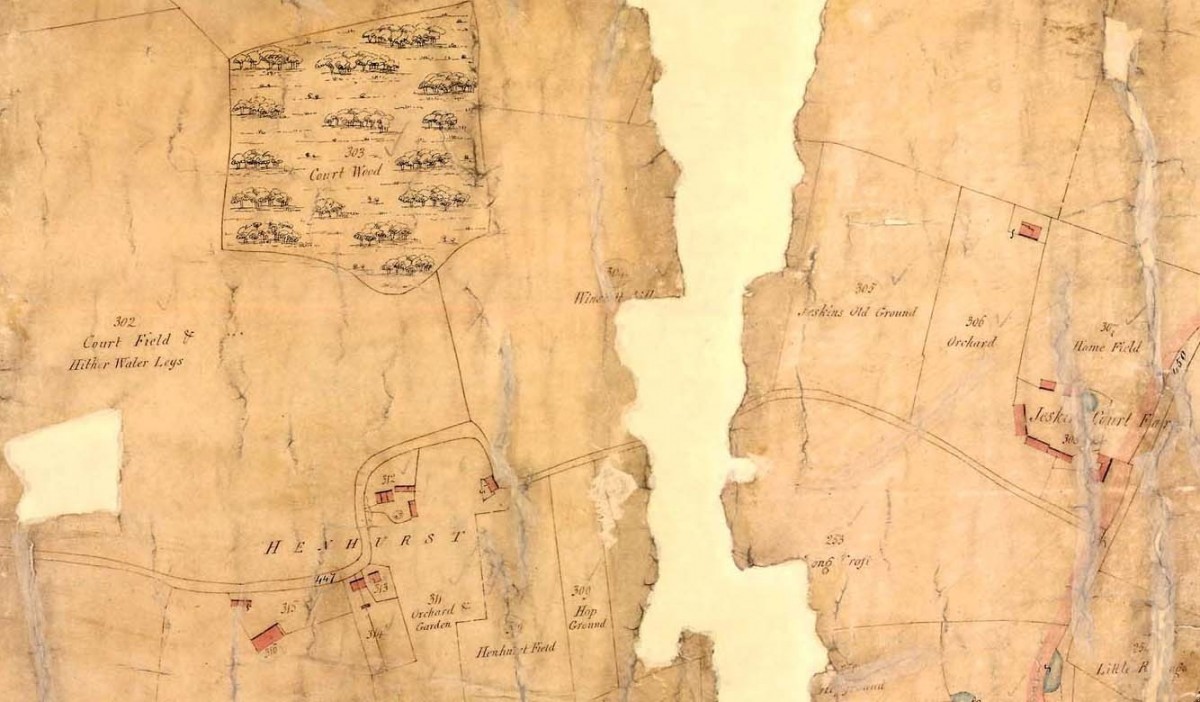
The manor house, Hennerst or Hennarst Courte, was still standing in 1572. The Tithe Map of 1840 (above) shows a small house with outbuildings, around a pond at parcel 312, within a square loop in the lane west of Court Wood [east being at the top of the map]. The loop existed until 1903 but had gone by 1920. The house and buildings were slightly sheltered in a hollow on the SW facing hill slope. However even if this house was medieval, it was too small to be more than a fragment of Henhurst Court.
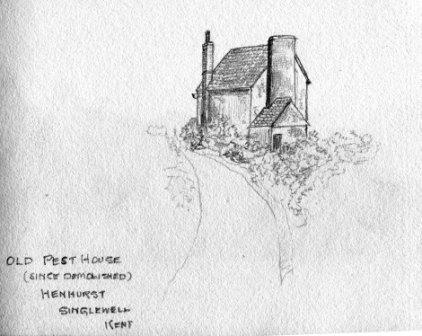
[A A Arnold recounted in 1905 ‘A little to the north of this site, on the summit of the hill, is an old brick and timber double cottage still known as “The High House at Henhurst” It may be seen for many miles around.’ A sketch, probably of this cottage, by H Whiting c.1920 but entitled The Old Pest House, is inserted here.]
Early Saxon and Norman lords
By 1086, the year of the Domesday Survey, Hanehest was one of many manors acquired legally or otherwise, by Bishop Odo of Bayeaux, William the Conqueror’s half-brother. Ansgot of Rochester was Odo’s tenant there2 and it accounted for a ½ sulung (perhaps 100 acres). When Ansgot had acquired the estate it was worth 30s and now 40s. There was land for 1 plough, which was on his demesne land. There were 2 villagers and 4 slaves. But two years later Odo was forced to surrender the manor.
Henneherste was again assessed at a ½ sulung in 1100 in the Domesday Monachorum survey and Ansgot of Rochester still held it, but now of the Archbishop of Canterbury. Ansgot also held Maplescombe, Hoo, Beckenham, Aldington, Stockbury, Great Delce and Stoke4.
In a charter, probably of 1108, Gotcelin de Haenherste held the manor5 and was one of many who donated the tithes of their manors to the monks of St Andrew’s Priory, Rochester for the use of the poor. The donations were confirmed in later years by successive archbishops. Hasted says that Gotcelin later became a monk at St Andrew’s Priory6. We hear of no successor and the manor may even have been abandoned for a time. After Gotcelin’s death Henhurst must have reverted to the Crown, as in 1169 Henry II granted it to William de Lanvelei7, one of that king’s administrators in Brittany who came to England with him in 1171 or 11728.
The family of Lanvelei
The Lanvelei family continued at Henhurst for 3 generations. It was probably the favourite manor of the first of them, for he styled himself William de Lanvelei of Henhurst. No doubt he built himself a substantial house here, though no trace of it remains above ground. The first William de Lanvelei died c.1181. The last payment to the Exchequer of quit rent for his Henhurst lands appears in the Pipe Roll of 1189 – the first year of Richard I9.
William’s son William II de Lanvelei inherited Henhurst and closer to his own desires, governed Colchester Castle, until he died in 120410.
He was succeeded by his son William III de Lanvelei, who was on King John’s expedition to Poitou in 1214. Then he changed his allegiance to support the rebel barons and he was one of the council of Twenty Five who witnessed and were sureties for Magna Carta in 1215. William III died possessed of Henhurst in 121711. His infant daughter Hawise became the ward of Hubert de Burgh, justiciar for England and she was in his custody in 1219. Her manors of Chauk’ and Henneherst were now valued at £40 per annum12.
The family of Pakenham
There follows a gap of 70 years or more in the documentary record until Hasted notes from an Escheat Roll (IPM) of 1287 that Edmund I, son of William de Pakenham had died possessed of the manor13. However this does not fit with the known ancestry of the Pakenhams and Hasted’s Edmund I may in fact be the same man as Edmund II below. Hasted further asserts that Henhurst was then given to the Priory of Leeds which held it until the dissolution. This idea, and the later descent of Henhurst to George Brooke Lord Cobham, seem to derive from Thomas Philipott. A A Arnold and more recently Nicola Bannister14 follow Hasted. Dr Bannister also cites Sherwood’s transcript of the Cartulary of Leeds Priory15 in support of this. However, given the evidence below of Henhurst’s ownership by the Pakenham family and others up to the reign of Elizabeth, its gift to Leeds seems very unlikely, particularly as neither Sherwood’s Cartulary nor Dugdale’s Monasticon16 mentions Henhurst or Cobham at all in connection with Leeds.
Possibly all that was given to Leeds was a portion of the tithes of Henhurst, which we know was transferred by a grant of 1541 to the Dean and Chapter of Rochester cathedral 32.
It is true that the Pakenhams had acquired Henhurst by the early 14th century or earlier. In 1305 William son of Sir John de Pakenham exchanged lands in Norfolk and Suffolk and the manor of Henhurst in Kent, all of which had belonged to Sir John, with his uncle Sir William de Pakenham of Surrey for lands in Pakenham and elsewhere. William’s son John de Pakenham released his interests in these manors to Sir William de Pakenham of Surrey’s son Edmund II, at the same time 17.
By 1332 Sir Edmund II son of Sir William had died posssessed of “a messuage called Henherst” held by service of 1/40th part of a knight’s fee from Robert de Ufford who was soon to become Earl of Suffolk. The value of the manor was 3s4d pa and it included 120 ac of land, 3 ac of meadow, 80 ac of pasture, 3 ac of woodland & 33s per annum rents. Edmund de Pakenham III his son, aged 30 years was his next heir18 and had livery of Henhurst and other lands in 1333. He died in March 1350-51.
By 1352 Rose, widow of Edmund II de Pakenham had died. Her dower included 1/3rd part of the manor of Henherst, now held of Ralph Earl of Stafford as of his castle of Tonebregge, by a 1/40th part of a knight’s fee19. The remaining 2/3rds part of Henhurst had already passed to her grandson Sir Thomas de Pakenham in 1351. However in 1353 this Sir Thomas made a grant of all the lands he had received from his father and from his grandmother Rose, to his mother Mary de Pakenham. Thus Mary now held the whole of the manor of Henhurst20. Sir Thomas died in 1357.
In June and July 1358, his mother Mary, widow of Sir Edmund III de Pakenham (who had died 7 years previously) enrolled two deeds on the Close Roll. Firstly a suspended grant of rent of £20 per annum from her manor of Ditton Valoyns, Cambridgeshire, to Sir William Vaghan and his son Sir Thomas. Mary’s deed was dated at Henherst suggesting that she still occupied the manor house. Secondly an indenture dated at Bury St Edmunds jointly with the Vaghans, to guarantee her recent conveyance to them of Henhurst Manor, against claims by her son’s heirs. While there was no claim, the £20 grant to them would have no force21. Mary de Pakenham died in 1362 22.
The Vaghans and their inheritance
Sir William Vaghan died in the late 1350s. When his son Sir Thomas Vaghan died in 1361, he held the manor of Henhurst by Shchyngeldwell from the Earl of Stafford, as of his manor Tonebregg, but now by service of 1/8th part of a knight’s fee; and he left an infant son Hamo 23. Hamo Vaghan would have inherited Henhurst and any other property of his father when he came of age about 1381 but his inquisition post mortem of 139424 explains that “long before his death” he had granted his Essex and Northamptonshire manors to Roger Bokilton and 2 others. The inquisition mentions no Kent properties, so Henhurst had probably already been granted elsewhere.
The documents show a complex series of exchanges around the turn of the century 22,27,30. At Henhurst, Hamo’s mother Alesia Vaghan widow of Sir Thomas, presumably received 1/3rd of the manor as her dower, 11 years before she married one John Burton in 1372. Alesia outlived her son, so that only 2/3rds of the manor could ever have gone to Hamo in his lifetime. Some years before 1420, Roger Bokilton had somehow acquired half of the manor, as his three children Philip, Margaret and Katharine each inherited 1/6th of the manor ie 1/3rd of half of it. An inquisition post mortem of November 1420 25 found that Margaret, who was widow of Sir Richard Mytton, had died in August 1420 and left 1/6 of the manor to her son William aged 8. Another inquisition of the same date 26 found that Philip Bokilton had died in September 1420 and left 1/6 of the manor to his sister Katharine, aged 49 (who had married John Falke of Hereford). Katharine must already have had the other 1/6th. The manor was held of Humphrey, son and heir of Edmund formerly Earl of Stafford, who was then a minor.
The descent of the other half of the manor is unclear, but all seems to have been resolved in the summer months of 1437 when Nicholas Falke (son of Katharine and John), Hugh Dorsete and William Mytton each granted portions of Henhurst to John Harpur and thus reunited the manor 29
Harpurs and Joskyns
John Harpur of Ruysshale, Essex first appears holding the wardship of part of Henhurst in 1419-22. He and his wife Eleanor acquired the manors of West Tilbury in Essex, Pomfret in Middlesex and the whole of Henhurst in Kent in 1437. VCH notes that the flooding of much of the Isle of Dogs in 1448 was attributed to neglect of the river walls on the SW side by the freeholder, presumably as it fell in the manor of Pomfret in Stepney, which John Harpur then held 27.
In 1488, William Harpur, who may have been the son of John and Eleanor, let the manor of Henhurst to Richard Joskyn, a tailor of London but lately from Henhurst, for a 10 year term at an annual rent of £8. All apparently went well until the end of the ten year term, when Harpur claimed that Joskyn owed him £6 arrears of rent for 1497 and £8 for a further year, 1498. Joskyn claimed that he did not owe it. The case was heard in the court of common pleas in London in 1500 and we hear no more, so it was presumably settled 31.
From about this time onward, while the manor of Henhurst continued to exist and its lands continued to be farmed by tenants, the manorial buildings themselves were probably in decline. What did those manorial buildings amount to? In England as in Normandy in the late 12th century when the Lanvelei family were granted the manor, the usual arrangement would be a first floor chamber building (with storage beneath) for the lord, probably of flint and stone, and a ground floor aisled hall of timber for his supporters. There would be a detached kitchen close by and barns and other buildings, all within an enclosure 38. During the 13th century, the manor should have been flourishing, but we actually know little about it until the advent of the Pakenhams. The widowed Lady Mary de Pakenham may still have occupied manorial buildings of this sort in 1358. A decline in their status probably ensued when it was inherited by a minor in 1362 and its ownership then fragmented for 75 years. Given that the Harpurs were some distance away in Essex and that one of them neglected his Stepney property, Henhurst may have been in a poor state by the time John Harpur let it to Richard Joskyn in 1488. There is a suggestion from a rental that Hennerst Court was still standing and recognisable in 1572 39 but after that we really do not know what happened to it.
Without more evidence, particularly from excavation, we do not know whether Richard Joskyn occupied the old Henhurst manor house in 1488 or whether he now set about building the structure which forms the core of the present house named Jeskins or Jeskyns Court. The house is recorded as 16th century in the Kent Historic Environment Record, despite its 18th century brick frontage. The family, known variously as Joskyn, Geskyn or Jeskin, had been active in the Cobham area for well over a century, Walter son of Walter buying land in 1335 33, John witnessing deeds in 1336 34, Walter lending money in 1355 35 and having an official duty for the new Cobham College in 1369 36. Richard the elder, husbondman, perhaps the father of the tenant above, received a pardon in 1450 for taking part in Jack Cade’s rebellion, as did John Joskyn, yoman and seven others in Cobham parish 37. John Joskyn held 7 acres at Toltyngtrowgh in 1460 38a.
The last mention of the Joskyn family in Cobham (and in Kent) was in a court case of 1533-1538 when John and Agnes, the children and heirs of Richard Joskyn were selling gavelkind lands in Cobham, to George son of William Wright and Nicholas (or Thomas?) Harper, who had married William’s widow41. The significance of this transaction is unclear.
It should be noted that Edward Hasted’s account discussed above, although it assigns Henhurst to the Priory of Leeds from the later 13th century up to the dissolution, does eventually bring the manor back to the Harpur family, to a line of possession that we have traced back to 1305 by a different route. Thus Mr Hasted and I agree that by 1547, Henhurst manor was owned by Sir George Harpur of Sutton Valence, who was then sheriff of Kent. The remainder of this account follows Hasted, except where references or descriptions indicate otherwise.
Sir George’s son, another George Harpur, joined Sir Thomas Wyatt’s ill-fated rebellion in 1554 and was committed to the Tower, but he was released by Queen Mary’s “especial grace” next year and pardoned. The main interests of the Harpur family were in Sutton Valence and they may have visited Cobham only infrequently. Early in Queen Elizabeth’s reign George Harpur’s son Sir Edward sold Henhurst manor to Thomas Wright.
The Wrights, Dr Aubert, the Giffords and John Staples Esq
The Wrights held the manor for 80 years, but they were not without their difficulties. Thomas’s son George had no descendants and he left the manor to his kinsman Sir George Wright. Afterwards, when Thomas Wright the son of Sir George, possessed Henhurst manor, he was for reasons unknown, proclaimed an outlaw. Probably to prevent its forfeiture, he sold it in March 1638 to Queen Henrietta Maria’s Physician, Dr Maurice Aubert or Obert 42. Perhaps the outlawry was related to the imminence of the Civil War; however after a few years Aubert sold the manor on to Henry Gifford esq of Burstall, Leicestershire.
The Giffords, being Leicestershire people, may not have taken much interest in Henhurst, especially when Henry Gifford was created a baronet in 1660. He left the manor to his son Sir John Gifford in April 1665. Sir John died in 1707 and left the manor to his son of the same name, who died without issue in 1736. His sister and heir Mary Anne Gifford inherited his lands in Kent and other counties 43 and she sold Henhurst manor to John Staples Esq of the Temple, London in 1750.
John Staples’ interests seem to have been in East Grinstead, Sussex and of course in the legal world in London. In his time, a lease of the Manor of Henhurst of 1788 described “all that messuage, tenement or farm known by the name of Giskins or Henhurst Hall” 40. If this tells us anything, it is that Jeskyns Court had now taken over as the focus of the Henhurst estate, as far as its tenant farmers were concerned. John Staples died unmarried and his will, proved in 1789, left Henhurst manor and all his houses and lands in Cobham, together with the half of the tithes of Henhurst which he had leased from the Dean & Chapter of Rochester, to Percival Hart Dyke, 2nd son of Sir John Dixon Dyke Bart. of Lullingstone Castle and Lady Dyke, who was his relative 44.
The Dyke family of Lullingstone
Sir Percival Hart Dyke, who was owner in Hasted’s time, owned a great number of properties, especially in Kent. His lengthy will, written in 1845 and proved in September 1846, demised so many properties that Henhurst was not mentioned by name, but was included in “All and every other my manors, messuages or tenements” in the county of Kent which he left to trustees to the use of his eldest son Percival Hart Dyke 45.
Mr Arnold tells us that manor was the property of T C Colyer-Fergusson Esq of Wombwell Hall in his time, 1905. It is not clear when the ownership of Henhurst manor had been separated from ownership of Jeskyns Court, but 1845 seems a possible year. He also says that T H Baker of Owlets had told him that “he and his family before him had owned Jeskyns for many years”.
The Tithe schedule of 1845 lists land parcels under the heading of “Henhurst Hard”(?) which include the “house, buildings, yard, garden and pond called Jeskins Court”. Thomas Baker was then the owner and William Pemble Wells the occupier. The “local” copy of the Tithe Map in Medway Archives, which is dated 1840, shows what must be the manor of Henhurst outlined in pink. Nichola Bannister, evidently working from the National Archives copy, which does not have this marking, nevertheless found a useful description of the bounds in 1728: “bounded by the lane from Dabs Place to ye house of ye said Mr Hayes towards ye south to a lane leading from Mr Hayes said house to St Thomas’ Well towards ye east, to a lane leadingfrom St Thomas’ Well towards Shingle Well north, and being co-extended with ye parish of Cobham boundeth on ye parishes of Ifield or Northfleet of both of ye said parishes towards ye west” 46. This description (except for the compass directions) agrees with the Tithe Map pink area, save that it does not include the area of Clay Lane Woods which lies north of the A2 trunk road.
Much 17th and 18th century data on the lessees of the tithes of the manor and on the tenants of the manor survives and is listed in the Annex below.
The Forestry Commission
The farm continued on through the 20th century and at some stage the land was separated from the house of Jeskins Court. A Forestry Commission leaflet explains that “a former farm is now a large open-space recreational area with areas being developed as new wildlife habitats. The farm was put on the market in 2005, following the death of its owner.” Assistance from the Deputy Prime Minister’s Sustainable Communities Fund was given to the Commission to make this recreational development possible.
(R.A.C. Cockett, August 2018)
Note 1: It should be borne in mind that another manor of Henhurst exists in Yalding parish in Twyford Hundred and there is a Henhurst Farm at Staplehurst, in Scray Hundred. There is also a Hundred of Henhurst in Sussex and the name occurs elsewhere in England.
Note 2: This Note has particularly benefitted from Mr A A Arnold’s studies of the Cobham manors published in 1905 in Archaeologia Cantiana Vol XXVII, though I take issue with him as to any possession by Leeds Abbey.
Footnotes
[TNA references below from the British History Online website accessed March 2018.]
1 Brooks 1994: pp16-20, p363
2 Morgan 1983: 5,109
3 Gelling 2000: pp234-5
4 Douglas 1944: p103
5 Grant at Medway Archives ref: DRc_T057 (No.5) A copy of a lost charter of Bishop Gundulph dated 1091. This is a later inspeximus made in 1260 and recites the original text. Unfortunately internal evidence in the text is not compatible with the date 1091, though the year is clearly written. However the facts of Gundulph’s charter do seem to have been accepted in later centuries. The year 1108 was the only time when he and all the persons in the witness list were alive and in office, so AD1108 seems a reasonable date.
6 Hasted 1797: p427
7 TNA Pipe Rolls ref E372/15 Rot.12 m1
8 Saul 2018
9 TNA Pipe Rolls ref E372/35 Rot.14 m1
10 Saul 2018
11 Saul 2018
12 TNA Book of Fees 1920: p269
13 Hasted 1778 1st Edn only, Vol I: p499
14 Bannister p7
15 Sherwood: pp25-34
16 Dugdale: p215
17 TNA Close Roll Ed I, 1305: Vol 5 April Mem 15d
18 TNA Calendar of Inquisitions Post Mortem 1332: Ref C135/31/34 copies Nov 2012
19 TNA Calendar of Inquisitions Post Mortem Ed III, 1353: Ref C135/124/3 [Rose de Pakenham]
20 TNA Grant 1353: Ref E326/3786 [Thomas to Mary]
21 TNA Close Rolls Ed III, June 1358: Vol 10 pp508-12 [Rose, Wm & Thos]
22 TNA Calendar of Inquisitions Post Mortem 1361: Vol 11 File 163 page 154 [Mary de Pakenham]
23 TNA Calendar of Inquisitions Post Mortem 1361: Vol 11 No.167 page 262 [Thos Vaghan]
24 TNA Calendar of Inquisitions Post Mortem 1394: Vol 17 pp209-232 [Hamo Vaghan]
25 TNA Calendar of Inquisitions Post Mortem 1420: Ref C138/44/8 [Margaret Mutton]
26 TNA Calendar of Inquisitions Post Mortem 1420: Ref C138/47/48 [Philip Bokilton]
27 VCH Hist of Cty of Middlesex 1998: Vol 11 Stepney
28 TNA Calendar of Close Rolls Hen VI, Dec 1422: Vol 1 pp49-51
29 TNA Calendar of Close Rolls Hen VI, May 1437: Vol 3 pp119-124
30 TNA Fines for Diverse Counties Hen VI, anno 1, 14, 36
31 TNA Court of Common Pleas CP40/952 Rot 258d Easter term 1500
32 TNA Letters & Papers, Foreign & Domestic, Hen VIII, Vol 16 1540-1541: No.947 Grants in June 1541: 42 Rochester Cathedral
33 TNA Ancient Deeds, Series D: Edw III 1335: Ref E210/2175
34 Medway Archives Rochester Priory deeds 1336: Ref DRc/T160/1&2
35 TNA Petty Bag Records 1355: Ref C241/134/171
36 TNA Calendar of Patent Rolls Edw III 1369: p283
37 TNA Calendar of Patent Rolls Hen VI 1450: p338
38 Davis 1993: p2
38a Arnold 1905: p132
39 Arnold 1905: p101
40 Arnold 1905: p112
41 TNA court action: 1533-38. Ref C1/832/50-52
42 TNA Calendar of State Papers Domestic Charles I March 17th 1637-8
43 TNA Probate copy of will of Sir John Gifford June 1737: Ref AR/40/2
44 TNA Probate copy of will of John Staples Esqr.1789: Ref Prob.11/1179/347
45 TNA Probate copy of will of Sir Percival Hart-Dyke Bart: Ref Prob.11/2041/395
46 Medway Archives Ref CCRc T35/1-27
Bibliography
Arnold, A A 1905. Cobham and its Manors: in Archaeologia Cantiana Volume XXVII
Bannister, Nicola R 2005. Jeskyns Farm, Cobham: Archive Assessment Overview
Book of Fees Vol I 1920, (TNA Miscellaneous Series I: Ref E164 Vols V & VI)
Brooks, Nicholas P 1994. Traffic and Politics: The Construction and Management of Rochester Bridge AD 43 – 1993, Rochester Bridge AD 43- 1381
Davis, John, 1993. Hall and Chamber: English domestic planning 1000-1250; article in Manorial Domestic Buildings in England and Northern France Ed. Gwyn Meiron-Jones & Michael Jones, Soc. of Antiquaries of London 1993
Douglas, David C, Ed. 1944. The Domesday Monachorum of Christ Church Canterbury
Dugdale, Sir William and others 1830 (reprint 1977) The Monasticon Vol VI part (1)
Gelling, Margaret & Cole, Ann 2000. The Landscape of Place-Names
Hasted, Edward 1797. The History and Topographical Survey of the County of Kent 2nd Edn Vol III
Morgan, Philip, Ed. 1983. Domesday Book: Kent. Sankaran, Veronica, Trans. Published by Philimore
Saul, Nigel, Prof at Royal Holloway University of London, 2 pages on website Ancestry.co.uk: read 3rd Mar 2018
Sherwood, Leslie 1951. The Cartulary of Leeds Priory: in Archaeologia Cantiana Volume XXVII
Annexe
Lessees of the tithes of Henhurst Manor
The Dean & Chapter of Rochester leased out their half of the tithes and recorded the lessees: in 1661 under the Gifford ownership of the manor there was Stephen Alcocke, in 1676 Christopher Venman, in 1700 Francis Wynull, in 1700 and 1714 Bonham Hayes and in 1721, 1729, 1735, 1742 and 1749, Richard Hayes. Once John Staples owned the manor, he was lessee in 1767, 1774, 1781 and 1788. With the change in ownership to Percival Hart Dyke (as yet still Esquire not Baronet) he was lessee in 1795 and 1802. In 1807, they conveyed their moiety of the tithes to Mr Dyke and his trustees under the powers of the Land Tax Redemption Acts, for £527.47
Tenants of Henhurst Manor
The Chapter Book of the Dean & Chapter of Rochester Cathedral also lists the tenants of Henhurst Manor in 1699, transcribed from a Court Roll. Total of lands about 130 acres.48
A list of 1770 loaned to AA Arnold by the Misses Stevens of Cobham Parsonage, describes the lands and tenants of Henhurst manor subject to pay tithes, more than half of these being occupied by a Mrs Comport.49
1788 lease by James Staples to Mr W Comport of “All that the manor of Henhurst and all and singular the rents of Assize, perquisites, profits of courts etc and all that messuage, tenement or farm known by the name of Giskins or Henhurst Hall”.50
An insurance document of William Comport of Cobham dated 1791 insured Cruches and Henhurst farms.51
Richard Hayes’ [published] diary of 1834 mentions Geskyns Farm was 356 acres.
References for Annexe:
47 Stevens c.1935: p35
48 Arnold, pp111-112 op cit above
49 Actual source unclear, but printed by AA Arnold, pp124-126 op cit above.
50 Arnold, p112 op cit above
51 Stevens op cit above
Stevens, E J c.1935. Chapter Book of the Dean & Chapter of Rochester Cathedral. Extracts transcribed by Miss E J Stevens, who lived at Cobham Parsonage.
SURVEY ASSESSMENT OF JESKYNS COURT, COBHAM, KENT
An examination of the standing building by R A C Cockett in June 2018
The house and its setting
Jeskyns Court lies at NGR TQ64976911, 1.2km west of Cobham parish church and 1.35km south of Watling Street. Jeskyns Road, to the south is at 83 m AOD.The house is aligned a few degrees west of south. To simplify this note, I have assumed that the Jeskyns Road frontage faces due south and the garden frontage towards Watling Street, the A2 road, faces north. From the road the house appears to be of early 18th century date. The clue that it is otherwise is the absence of an entrance in the long south frontage.The present house at Jeskyns Court consists of a central E-W range, parallel with Jeskyns Road, with a later cross-wing at the W end and a small, earlier cross-wing at the E end.
West wing
The W cross-wing was not examined internally but its sash windows are recessed behind the window jambs. They are larger than those of the central range and have more slender glazing bars. The wing is constructed of red brick and is probably of late 18th century date. At the time of building it presumably included a west-facing front door. The roof of this wing is about ½ m higher than that of the central range and this can be seen from the S. The brickwork is in Flemish bond.
Central range
The central range of the house is timber framed, though this is not visible externally as it has been encased in red brick in English bond. It seems likely that the W end of the central range which now abuts the W cross-wing, was originally an end wall with an exterior gable end, ie it was not hipped like the E end. This gable wall is impressively close-studded and the S wall may originally have been similar. An earlier, S-facing front door led to a cross-passage and a back door facing N, but both are now blocked. When the S wall was cased in brick, perhaps in the 16th century, an opening, with a brick relieving arch, was left for the front door. The sash windows of the central range are perhaps early 18th century, as their frames are flush with the front face of the wall.
Internally, the central range of the house has a side purlin roof with collar timbers. Wind braces are visible in the roof plane above purlin level. These features suggest a late 15th century date for the original building of this range. The central chimney stack is not of an early date; the red brick fireplaces are substantial, but probably 19th century. In this case, perhaps the original chimney stack was external and was located at the back. The staircases are late, except for the newel posts of the attic stairs which could be late 16th century. There is a small brick structure of indeterminate date in a NE facing angle at the back.
At the E end of the central range where it would once have abutted the early cross-wing (see below), is a pair of service doorways set between a ground cill and a ceiling girder. The doorways have 3-centred heads and plain spandrels set in the tops of their frames. On their W faces, ie away from the cross-wing, a cavetto outlines the shape of each doorway. A ½-round moulding frames the rectangle of each door frame and terminates in pyramid stops at the bottom. These doorways would have led to a buttery and pantry in the cross-wing and clearly comprise the E side of the cross passage through the house, the W side now being lost or concealed. The locations of the original exterior doorways to the N and S, now blocked, can be seen in the brickwork outside.
East wing
The E cross-wing has the remnants of a collar purlin and crown post roof. A single plain embedded crown post survives behind the line of the back wall of the central range. One collar purlin sits on a tenon on the top of the post and extends N for about 2m in contact with two collars, but it is cut away S of the crown post. The post was braced upwards to the collar purlin (one now survives) and has mortices for braces (now missing) down to a tie beam. There are 3 or so remaining collars to the N but the rest of the roof structure is missing or cut away for a late chimney stack. Nothing remains at roof level to the S of the crown post. The crown post is seated on a substantial canted tie beam and a jowelled post is visible in the room below at the E end of the tie beam. A mortice in the jowl originally housed the tenon of a downward brace (now missing) to a horizontal timber below, but a rebate in the edge of the post appears to have been made for a door (also missing) which must have displaced the brace.
Extension of the central range
It appears that the central range of the house was extended E across the end of the cross wing at first floor level. Various heavy ceiling timbers can be seen in the ground floor rooms and may have been part of the original cross-wing. Given that only one frame of the E cross-wing survives, a date at some time in the 14th century is the closest that can be suggested for it (and the phase of the house to which it related). The cross-wing was arguably of too high quality to have been a cottage but too narrow to have been a complete house in itself. So a wing was probably its original function.
Stratified medieval pottery
Three pottery sherds were found on a buried chalk surface 5 m to the E of the house. All were of a hard, fully reduced grey sandy fabric, probably dating between 1250 and 1400 AD.
Dates, phasing and identity
Despite the poor survival of parts of the building, it is clear that a house of 14th century date existed here and was largely rebuilt in the late 15th century. The house was refaced in brick, probably a century later and rewindowed in the early 18th century. A larger cross-wing was added at the end of that century and this, with minor changes, is what survives today. It is not really possible to say whether this house was the medieval manor of Henhurst Court.